
How to spot a fake flight booking agent
Learn how to spot a fake flight booking agent, verify your flight ticket and avoid common booking scams before sending your money.
How to Spot a Fake Flight Booking Agent Before You Lose Your Money
Planning a trip is exciting. You’re checking destinations, calculating your budget, imagining airport fits and probably already thinking about what you’ll post when you land.
Then you find a flight agent offering a ticket at a price that looks almost too good to be true.
Suddenly, you're tempted.
But before you send that money, pause.
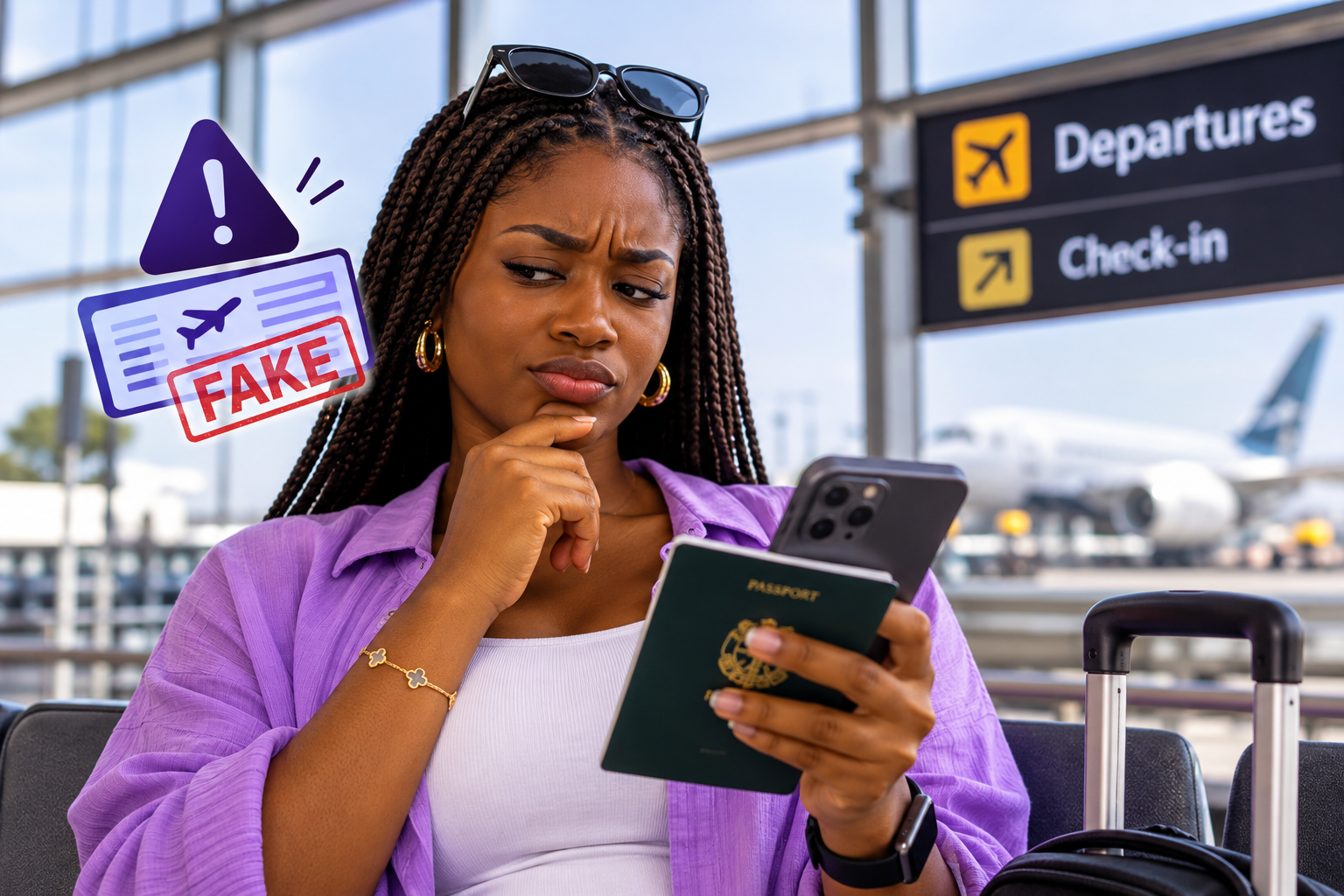
Fake flight booking agents are a real risk for travellers. Some advertise ridiculously cheap fares, send convincing booking confirmations and disappear once payment is made. Others issue fake tickets or make bookings that never become confirmed tickets.
And the worst part? You may not discover anything is wrong until you're standing at the airport with your luggage.
Here are practical ways to spot a fake flight booking agent before your travel plans turn into an expensive lesson.
1. If the Price Is Too Good to Be True, Investigate It
We all love a good deal. Nobody wants to spend more on a flight than necessary.
However, if every other agent is quoting ₦1.2 million and one person suddenly offers the same route for ₦450,000, you need to ask questions.
Flight prices can vary depending on the airline, booking date, availability and fare conditions. But an unusually low price with no reasonable explanation should make you cautious.
Ask for:
The airline's name.
The exact travel date and route.
The baggage allowance.
The fare conditions.
A clear breakdown of what you're paying for.
A cheap ticket is great. A cheap ticket that doesn't exist is not.
2. Check Their Online Presence Beyond Instagram
A professional-looking Instagram page does not automatically mean an agent is legitimate.
Some fraudulent accounts have beautiful graphics, customer testimonials, branded flyers and even thousands of followers. Unfortunately, Canva cannot issue a flight ticket, lol.
Before dealing with an agent, investigate their online presence.
Check:
How long their social media account has existed.
Whether they have a consistent business name and contact details.
Whether their website, if available, looks legitimate.
Whether their comments contain genuine customer interactions.
Whether there are independent reviews outside their own page.
Look out for complaints about missing tickets, failed refunds or agents who stop responding after receiving payment.
Don't let a fine Instagram feed do your background checks for you.
3. Verify the Booking Directly With the Airline
This is one of the most important steps.
A booking confirmation screenshot is not enough proof that your ticket has been issued. Screenshots can be edited, and a reservation reference alone does not always mean you have a confirmed, paid ticket.
After booking, request your airline booking reference (PNR) and e-ticket number.
Then:
Visit the airline's official website or contact its customer service.
Use its booking-management or verification option where available.
Confirm that your name, route and travel dates are correct.
Ask the airline to confirm that your ticket has actually been issued.
If the agent refuses to provide the details you need to verify your booking, treat that as a serious warning sign.
4. Be Careful With Personal Bank Accounts
Imagine booking a flight through a company, but the agent asks you to transfer ₦800,000 to an account belonging to someone you've never heard of.
That doesn't automatically prove fraud, but it deserves an explanation.
Ask why payment is going to that account and request an official invoice or payment documentation.
Where possible, pay through the company's verified payment channel. Confirm the business name and account details before transferring money.
Also, be cautious when an agent keeps changing account numbers or insists that you must pay immediately to secure a supposedly disappearing offer.
Pressure is not proof of legitimacy.
5. Watch Out for Agents Who Rush You Into Paying
Some fraudulent agents create urgency to stop customers from asking questions.
You might hear things like:
"Pay now. The fare will increase in five minutes."
"There is only one seat left."
"I can't hold this price for you."
"Send the money first. I'll send the ticket immediately."
Airline fares and seat availability can change, but that doesn't mean you should abandon basic checks.
A legitimate booking process should allow you to understand what you're paying for and receive the necessary booking documentation.
If someone makes you feel like asking questions will cost you the deal, step back.
6. Don't Trust Testimonials Without Verifying Them
Testimonials can be useful, but they should never be your only proof.
A screenshot of someone saying "Thank you, I got my ticket" can easily be fabricated.
Look for reviews on independent platforms, tagged customer experiences and consistent feedback over time.
If possible, speak to someone who has actually used the agent's services.
And remember, even a legitimate agent can have a bad transaction. What matters is their track record, transparency and how they handle issues.
7. Pay Attention to How They Communicate
Communication tells you a lot about a business.
Be cautious if an agent:
Avoids answering straightforward questions.
Gives inconsistent information about your flight.
Refuses to provide a business address or verifiable contact details.
Keeps postponing the delivery of your ticket.
Becomes aggressive when you ask for proof of payment or booking details.
Professionalism is not just about speaking good English or having a polished logo. It's about being transparent, accountable and able to provide the service you're paying for.
8. Know the Difference Between a Reservation and an Issued Ticket
This is a detail many travellers overlook.
A flight reservation or booking reference is not necessarily the same as an issued ticket.
Some reservations are temporary and may expire if payment is not completed within the required period.
An issued e-ticket should have an e-ticket number, and the airline should be able to verify its status.
Before celebrating your booking, confirm that your ticket has been issued and that your travel details are correct.
9. What to Do If You Think You've Been Scammed
If you've already paid an agent and something feels wrong, don't wait until your departure date.
Take these steps immediately:
Contact the agent in writing and request your ticket details.
Contact the airline directly to verify whether a ticket exists.
Save all payment receipts, chats, invoices and account details.
Contact your bank or payment provider immediately if you suspect fraud. Ask whether the transaction can be traced, disputed or stopped.
Report the incident to the appropriate authorities if necessary.
The sooner you act, the better your chances of getting help.
Final Thoughts
Booking a flight should be the beginning of an exciting experience, not the start of a financial investigation.
Before sending money to any flight booking agent, take time to verify their business, check the payment details and confirm your ticket directly with the airline.
A little investigation today can save you from a very stressful airport experience tomorrow.